
Call us now
08045804504
Call us now
08045804504
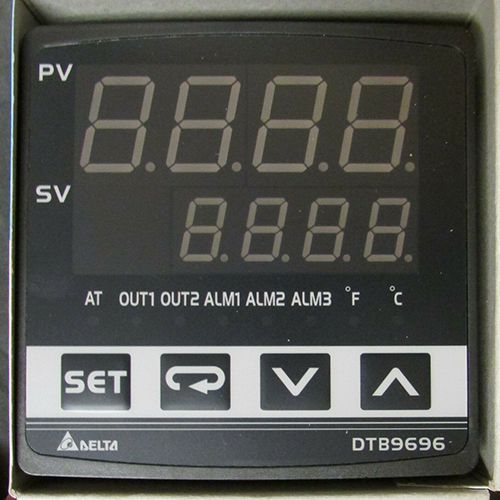
A temperature controller is a device that regulates temperature by comparing a measured temperature to a desired setpoint and then producing an output to control a heating or cooling element.
Sensor Input: A temperature sensor (e.g., thermocouple or RTD) measures the current temperature of the process.
Comparison: The controller compares this measured value to the desired setpoint.
Control Action: If there's a difference (error), the controller sends an output signal to a control element (heater, cooler, valve).
Feedback Loop: This continues as a loop to maintain the desired temperature.
| Type | Description |
|---|---|
| ON/OFF | Simplest form. Output is either fully ON or OFF. Best for less sensitive systems. |
| Proportional (P) | Reduces output as temperature nears setpoint. Prevents overshoot. |
| PID | Combines Proportional, Integral, and Derivative actions for precise control. |
| Fuzzy Logic / Adaptive | Uses logic-based decision-making for complex or variable processes. |
| Component | Function |
|---|---|
| Sensor | Detects process temperature (e.g., thermocouple, RTD) |
| Controller Unit | Processes input, compares with setpoint, generates control output |
| Output Element | Controls heating/cooling (e.g., relay, SSR, analog signal) |
| User Interface | Allows configuration of setpoint, parameters, and displays temperature info |
Setpoint Programming: Manual or automated setting of target temperature.
Auto/Manual Tuning: PID tuning for optimized response.
Alarms: High/low limit alerts.
Output Options: Relay, SSR, analog (420 mA, 010 V).
Communication: RS-485, Modbus, Ethernet for integration with SCADA or PLC systems.
Ramp/Soak Profiles: For applications like furnaces and ovens needing time-based temperature changes.

Price:




 Send Inquiry
 Send Inquiry
 Send SMS
 Call Me Free